Springfree 8ft x 13ft Large Oval Review (2026)
Last verified: 9 hours ago
Check Price on Amazon Buy via Superior PlayProduct prices and availability are accurate as of the date and time indicated and are subject to change. Any price and availability information displayed on Amazon at the time of purchase will apply to the purchase of this product.
Limiting: Frame (60/100)
PT Score Breakdown
How we calculate PT Scores →Pros and Cons
Pros
- Three injury zones removed by design: no springs to pinch, no frame to fall on, no gap at the mat edge
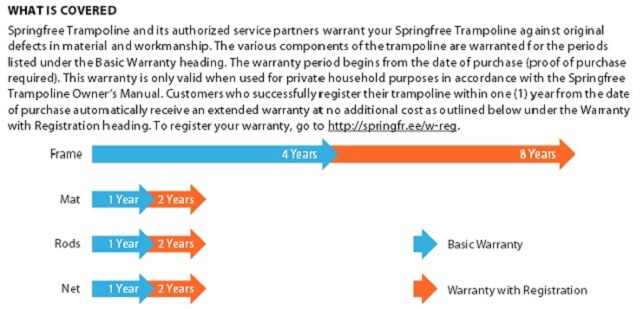
- Flat 10-year warranty across ALL components (frame, rods, mat, net, poles, pads), the strongest in the category
- SoftEdge mat tested to 3 million jumps and 1,500 lb of static load, UV-stable Permatron fabric
- Composite rods do not rust or corrode, and FlexiNet flexible poles cushion wayward jumpers back to centre instead of a rigid steel pole
- 92 sq ft oval jumping surface suits long, narrow yards a big round will not fit
- Vertically integrated manufacturer with its own patented springless design, the only one at scale
Cons
- The marketed "90% injury reduction" overstates the research, the peer-reviewed source (Eager et al. 2012) found about 35 percent vs US and 80 percent vs Australian trampolines, and was industry-funded and co-authored by the inventor
- Bounce is softer and less responsive than any spring system, performance-minded jumpers will notice
- Premium-tier price, well above a comparable spring-based round of similar footprint
- Repair parts are proprietary, a broken composite rod is not a commodity steel spring
- Thin published spec sheet for a premium product, no frame tube dimensions and no rod count for this size, so you are buying the design and the warranty, not a printed number
Full Review
PT Score: 6.0 / 10
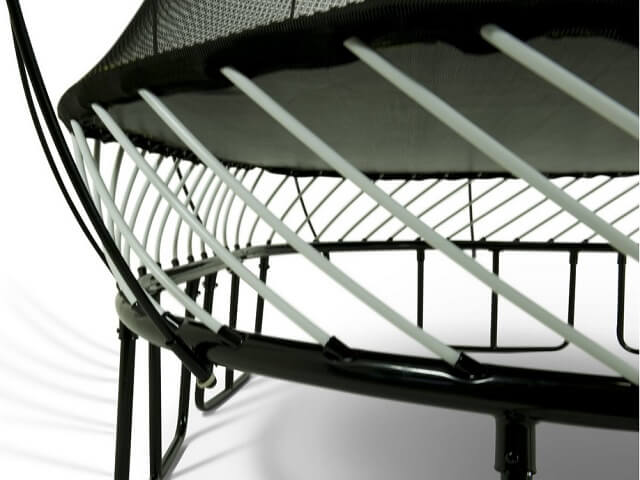
The Springfree 8ft by 13ft Large Oval, which Springfree calls the O92, did away with steel springs entirely. There are no steel coils around the mat. In their place, a bank of curved fiberglass rods sits about 18 inches beneath the jumping surface and does all the flexing. That single decision is the whole reason this trampoline exists, and it’s why safety-first parents keep putting it near the top of their shortlist. I’m Nino Andrasec, and this review separates what Springfree’s engineering genuinely delivers from what its marketing oversells.
Here’s the honest headline first. The structural safety of a springless build is real, and you can verify it without trusting a marketing slide. The famous “90 percent safer” number is a different story, and we’ll get to what the research actually says. This one lands at 6.0 out of 10. The rods, the mat, the enclosure, and the warranty are all strong, and the frame is the quieter part of the package, which is why the score sits where it does. Anyone cross-shopping the premium picks in our best trampolines guide should see the trade-offs before spending premium-tier money. If the springless concept already sold you, you can check the current price on Amazon, but the trade-offs below are worth a read first.
Key Specifications
| Specification | Detail |
|---|---|
| Shape and size | Oval, jumping mat 8 ft x 13 ft |
| Model code | O92 (the “92” is the mat’s 92 sq ft surface) |
| Jumping surface | 92 sq ft |
| Equivalent spring size | Roughly a 10 to 13 ft spring trampoline (approximate, dealer figure) |
| Space required | 18 ft x 23 ft (5 ft clearance on all sides) |
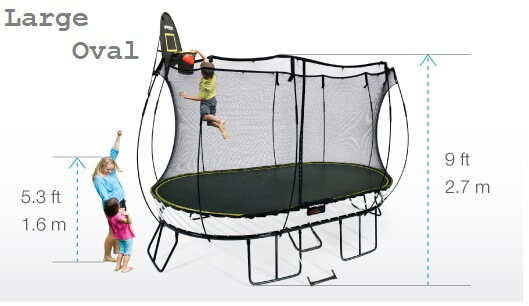
| Overall height (with FlexiNet) | 9.0 ft |
| Mat height off the ground | About 3 ft |
| Single-jumper weight limit | 220 lb |
| Total structural capacity | 1,500 lb (tested) |
| Mat material | Permatron, UV-stabilized |
| SoftEdge | Replaces the spring pad; tested to 3 million jumps and 1,500 lb static |
| Frame | Galvanized steel, three layers of rust protection, hidden below the mat |
| Rod system | Glass-reinforced composite rods, below the mat, corrosion-proof |
| Enclosure | FlexiNet, flexible composite poles, UV-resistant mesh |
| Warranty | 10 years across all components (frame, rods, mat, net, poles, pads) |
| Certification | ASTM F2225 and ASTM F381 (compliance stated; no lab report numbers published) |
| Manufacturer | Springfree Trampoline (vertically integrated, owns its own IP) |
| Price | Check current price |
One word on that price line. The Large Oval sits in the premium tier, and Springfree cycles its promotions, so we won’t print a number that goes stale next week. A deeper sale earlier this year has ended, which means any old figure you saw floating around is probably low now. Value math comes at the end.
How the Springless Design Works
A regular trampoline connects the mat to the frame with a ring of steel springs, all sitting at jumping height. That creates three known hazards: the springs, which pinch and catch; the rigid frame, which is a hard thing to land on; and the gap at the mat edge that a spring pad tries, and often fails, to cover.
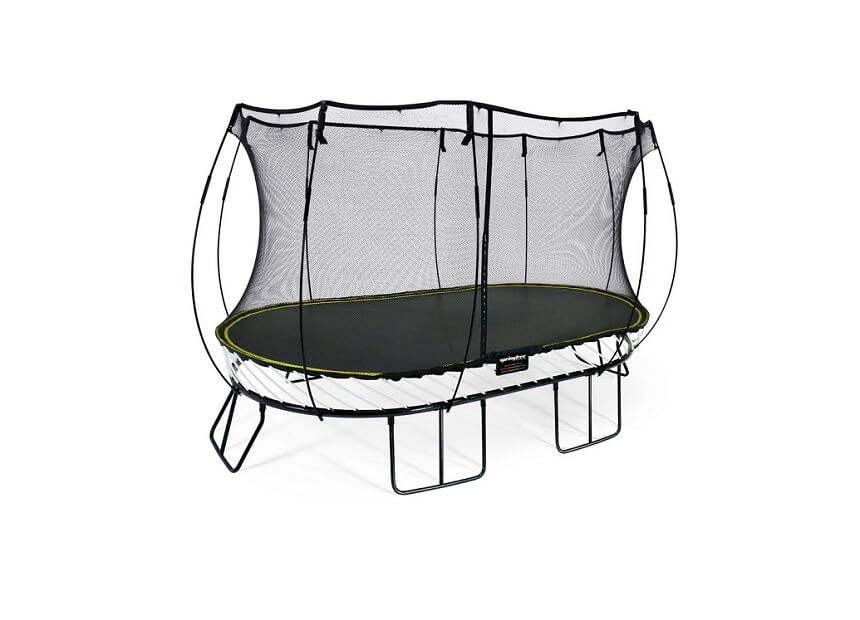
Springfree moves the whole frame and rod system about 18 inches below the mat. Curved composite rods flex up through the mat edge and return energy to the jumper. Because of where everything sits, three injury zones are gone by design: no springs to pinch, no frame within reach of a falling jumper, and no pad gap, since the SoftEdge surface is the boundary. You don’t need a study to confirm that. It follows from the geometry, and it’s the strongest thing this trampoline has going for it.
The “90 Percent Safer” Claim, Honestly
Springfree’s marketing leans hard on a “90 percent” injury-reduction figure, and you’ll see it repeated uncritically everywhere. It doesn’t hold up cleanly, so let’s handle it the way we’d want handled for us.
The claim traces to a peer-reviewed study by Eager and colleagues in the Journal of Paediatrics and Child Health (2012, PMC3505799). What it actually found was a reduction of roughly 35 percent versus US trampolines and about 80 percent versus Australian ones. Those are real numbers, but they aren’t 90 percent. Two caveats matter too. The research was funded in part by Springfree, and one co-author is Dr. Keith Alexander, the engineer who invented the trampoline being studied. That doesn’t make the findings worthless, but the headline figure earns a raised eyebrow.
So treat the marketing number with caution and the design with respect. The structural advantages above hold regardless of who funded which paper. No springs, no frame at mat level, and no pad gap are facts about the build, not conclusions from a contested survey.
Frame and Build
The frame on a Springfree is the part you’ll never see, and that’s the point. It’s galvanized steel, finished with what Springfree calls three layers of rust protection, and it sits well below the mat where no jumper can reach it. Springfree makes its own hardware rather than badging a factory’s output, which is rare in this category, and it backs the frame for a full 10 years. On the measures that matter for a hidden structural frame, corrosion resistance, load rating, and warranty, it does the job.
Now the honest note, and it’s a buyer-trust point rather than a fault. Springfree publishes a thin spec sheet. You won’t find the frame tube diameter, the wall gauge, or the rod count for this size on the product page or the dealer listings, and some spring-based competitors print all of it. What you’re buying here is the design, the warranty, and a track record, not a printed frame number. For most families that’s a fair trade, since the decade of coverage is what protects you if a part ever fails. For a buyer who decides strictly on published figures, know that Springfree asks for more trust in the design and less in the datasheet than some rivals do.
Bounce and Feel
The trade for all that safety engineering shows up in the bounce. A below-mat rod bed feels different from a steel-spring one. Owners describe it as softer and more cushioned, with less of the sharp rebound you get off a tight spring trampoline. For everyday family jumping that’s pleasant, and for younger kids it’s arguably better. If your teenager wants deep, responsive bounce for tricks, this isn’t the bed for it, and that’s a deliberate choice rather than a defect.
One more honest note lives here. The single-jumper limit is 220 lb, lower than the per-jumper ratings on several spring-based premium picks. Springfree’s design assumes one jumper at a time anyway, which is the safe rule on any trampoline, but heavier solo jumpers should clock that number first.
Size, Shape and Yard Fit
The Large Oval gives you 92 sq ft of surface, and the oval shape is the reason to pick it over a big round. A long, narrow footprint drops into yards a wide circle can’t fit. Plan for an 18 ft by 23 ft clear install area, since Springfree wants 5 ft of clearance on every side, and the height runs to 9 ft with the FlexiNet up, so watch for low branches and eaves. The oval also suits how families actually jump, a couple of kids taking turns rather than a crowd at once. Build that one-at-a-time habit early, whatever the structural rating says.
Warranty
This is where the O92 pulls clearly ahead. Springfree covers every major component for 10 years: frame, composite rods, mat and SoftEdge, FlexiNet, and poles. There’s no tiered small print quietly dropping the soft goods to two or three years, which is exactly what most competitors do. Plenty of premium spring trampolines give you a long frame warranty and a much shorter one on the mat, net, and pad, the parts that wear first. Springfree’s flat decade across the board is the strongest warranty in the consumer category, and on a trampoline you buy partly on trust, that coverage does real work.
Who This Is For
- Safety-first families. The design removes real injury zones from first principles, not just from a marketing slide.
- Owners of long, narrow yards. The oval footprint fits spaces a big round can’t, while still giving you 92 sq ft.
- Buyers who value low maintenance. No spring pad means nothing to blow off, degrade, or replace every couple of seasons.
- People who care about the warranty. A flat 10 years on every component is the best coverage in the category.
Who This Is NOT For
- Performance and athletic bouncers. The cushioned rod feel isn’t built for deep, responsive tumbling.
- Bargain hunters. This is premium-tier pricing, well above a comparable spring-based round of similar footprint.
- DIY repair fans. The rods are proprietary Springfree parts, not commodity springs from any hardware store.
- Spec-sheet purists. Springfree publishes fewer tube gauges and rod counts than some rivals do.
How It Compares
| Factor | Springfree Large Oval (O92) | AlleyOOP 14ft PowerBounce | ACON X 17ft | Jumpflex HERO 14ft |
|---|---|---|---|---|
| Mechanism | Composite rods, no springs | Steel springs, dual-layer | Steel springs | Steel springs |
| Injury-zone design | No springs, no frame at mat level, no pad gap | Spring pad and rigid frame | Spring pad and rigid frame | Spring pad and rigid frame |
| Bounce feel | Softer, cushioned by design | Tunable across 3 settings | Deep, responsive | Family-grade |
| Single-jumper limit | 220 lb | About 350 lb | Higher; see review | 350 lb |
| Warranty | 10 yr, all components | Lifetime frame | 10 yr frame, tiered soft goods | 10 yr frame |
| Tier | Premium (springless) | Top-tier | Premium | Upper-mid |
| PT review | This page | AlleyOOP PowerBounce review | ACON X 17ft review | Jumpflex HERO review |
Read that table by what you value. If the safety mechanism is your priority, nothing here matches the Springfree, since the rest are spring beds with the hazards that come with them. If you want deep, tunable, or athletic bounce, the AlleyOOP PowerBounce and the ACON X 17ft both out-jump it and publish more of their specs. The Jumpflex HERO is the interesting middle case, another premium build with its own thin-spec-sheet story at a friendlier price. And for a sunk-in install, the BERG Champion InGround 14ft is the in-ground option to look at.
The Large Oval is also one point in a wider line, with smaller Compact and Medium Ovals below it, a huge Jumbo Oval above, plus the popular Medium Round (R79) and Jumbo Square (S155) in other shapes. If the design appeals but the 8 by 13 footprint doesn’t fit, our trampoline buying guide covers picking a size and shape, and the full round trampolines category has the spring-based alternatives.
Is It Worth It?
Let’s talk money without quoting a figure that’ll be wrong next week. The Large Oval sits firmly in the premium tier, well above a comparable spring-based round of similar footprint, and the deeper sale from earlier this year has ended, so don’t anchor on an old price. The premium buys something specific: a genuinely different safety design, an edge system with no pad to replace, a flexing enclosure, and the best all-component warranty in the category.
One note on the listing we link to. It’s the bundle that ships with Springfree’s FlexrStep V2, an adjustable, lockable ladder that clips on for safe on and off access, which is genuinely handy for younger kids. That accessory is part of why this particular listing sits where it does on price. If you know you won’t use a ladder, it’s worth checking whether a trampoline-only listing runs cheaper before you buy.
What it doesn’t buy is commodity repairability. The rods are proprietary, so a replacement is a Springfree part, not a cheap spring from any hardware store. Owners report the rods hold up well, and the warranty covers them for a decade, but it’s a real difference from a spring trampoline you can patch with a bucket of universal springs. If the safety design is your reason, it’s worth it, and the warranty helps justify it. If you want the most surface per dollar, a premium spring trampoline stretches further.
Our Verdict
The Springfree Large Oval earns a 6.0 out of 10, and it’s easy to recommend to the right buyer. The rod system removes real injury zones by design, the SoftEdge does away with the pad you’d otherwise replace, the FlexiNet flexes wayward jumpers back to center, and the flat 10-year warranty leads the category. The frame is the quieter member of that group, a well-built, hidden, galvanized structure backed for a decade, and the only reason it doesn’t headline is that Springfree publishes less about it than some rivals. On this product, you’re buying the design and the warranty, not a printed frame number, and for its target buyer that’s a fair deal.
Buy it if safety is your first priority, you’ve got a long narrow yard, and you value a decade of coverage over cheap repairs. Skip it if you want athletic bounce, the lowest price per square foot, or a spec sheet to pick apart line by line. If it’s your trampoline, you can check the current price on Amazon and weigh it against the premium spring picks above.
Frequently Asked Questions
Is a Springfree trampoline worth the money?
If safety is your main reason, yes. You’re paying a premium for a design that removes real injury zones, an edge with no pad to replace, and the best warranty in the category. If you mostly want the largest surface for the lowest price, a premium spring trampoline gives more square footage per dollar.
Are Springfree trampolines actually safer than spring trampolines?
Structurally, yes, and you don’t need a study to see why: no springs to pinch, no frame within reach at mat level, and no gap at the edge. Springfree markets a “90 percent” figure, but the underlying research found closer to 35 percent versus US trampolines and about 80 percent versus Australian ones, and it was partly funded by Springfree and co-authored by the inventor. The design advantages are real regardless of the headline.
What size yard do I need for the 8×13 Large Oval?
Plan for a clear area of 18 ft by 23 ft, which builds in the 5 ft of clearance Springfree recommends on every side. The trampoline reaches 9 ft with the FlexiNet up, so also check for low branches, eaves, and power lines above the spot.
How does the bounce compare to a regular spring trampoline?
It feels softer and more cushioned. The below-mat rods return energy more gently than a tight spring bed, which owners like for family use and younger kids. If you want the sharp, deep rebound athletes use for tricks, a quality spring trampoline feels more responsive.
What is the Springfree warranty?
Springfree covers all major components for 10 years: frame, composite rods, mat and SoftEdge, FlexiNet, and poles. There’s no tiered coverage quietly dropping the soft goods to two or three years, which many competitors do. It’s the strongest warranty in the consumer trampoline market.
Can you replace Springfree rods, and are parts expensive?
You can, but they’re proprietary. A rod is a Springfree-sourced part, not a commodity spring you can buy anywhere, so it costs more than a hardware-store replacement. The upside is that rods are covered under the 10-year warranty and owners report they last, so replacements are uncommon in normal use.
Which Springfree should I buy: Oval, Round, or Square?
Pick the Oval, like this 8 by 13, when your yard is long and narrow and a big round won’t fit. The Medium Round (R79) is the more affordable entry point for a standard backyard. Go Square (S155) for the most jumping surface if you have the space. Match shape to your yard first, then size to your budget.
Product Photos
Price History
Get notified when the price drops
Set a target price and we'll email you when it's reached.